Paris, 1990 — The World, Since
Handed the world at nine years old, she chose — at every turn — to remake it: from Hermione Granger to the floor of the United Nations, where a single speech redrew the map of modern feminism and a generation of young men learned to say the word without flinching.
Emma Charlotte Duerre Watson was born in Paris on 15 April 1990 to English lawyers Jacqueline Luesby and Chris Watson, and raised in Oxfordshire after her parents separated — a child of two worlds, fluent in French and English, who would go on to inhabit many more. From the age of six she trained at the Stagecoach Theatre Arts school in Oxford, reciting poetry and acting in school productions long before any camera found her.
Cast as Hermione Granger at age nine, with no professional experience and eight auditions behind her, she spent the following decade becoming one of the most recognised faces on the planet — all while sitting GCSEs, then A-levels, refusing to let stardom interrupt her education. She achieved straight A's, including top marks in English, Geography, and Art.
While Hollywood offered the world on a plate, Watson chose Oxford and Brown. While tabloids chased celebrity, she launched feminist campaigns at the United Nations. Her biography reads less like a star's trajectory than a philosopher's argument: that privilege demands purpose, that fame is a platform, and that the most radical act a famous woman can perform is to think rigorously in public.
Today she stands at the intersection of cinema and social change — proof that the two can amplify each other rather than compete, and that a person formed entirely in public can still choose, deliberately, what to become.
Cast at nine with zero professional experience, Watson auditioned eight times before J.K. Rowling personally confirmed her as Hermione. Director Chris Columbus called her work "startlingly mature." The film shattered opening-weekend records worldwide.
Over nine years and eight films, Watson grew from child actress to adult star while the world watched. Her Hermione became a defining feminist icon for a generation — intelligent, courageous, fiercely principled.
Her first major role outside the Potter universe was praised as a revelation. Watson's Sam — emotionally complex, free-spirited — silenced all doubts about her range beyond Hermione.
A narcissistic, celebrity-obsessed teenager in Sofia Coppola's Hollywood satire — a deliberate, self-aware choice to subvert her own public image, with dry comic timing.
Watson returned to franchise scale as Belle, insisting on a more independent, intellectually grounded characterisation and performing her own singing. The highest-grossing live-action musical of its time.
Alongside Saoirse Ronan, Florence Pugh, and Meryl Streep in Greta Gerwig's celebrated adaptation — six Academy Award nominations including Best Picture. A career high-water mark.
Emma Watson — UN HeForShe Address, 2014
BA English Literature · 2011 – 2014 · Providence
Watson enrolled at Brown immediately after the final Potter film, commuting between lecture halls and film sets across two continents. She graduated in May 2014, describing the degree as her proudest achievement — above any film, any award, any premiere.
Study Year Abroad · English Literature · 2013
A year at Oxford fulfilled a lifelong ambition and deepened her engagement with the feminist theory and literature — bell hooks, de Beauvoir, Woolf — that would underpin her activism. She has described Oxford as a place that changed how she sees the world.
In July 2014, UN Women appointed Watson its youngest-ever Goodwill Ambassador. Two months later, on 20 September, she stood before the General Assembly in New York and delivered the address that would define her public life — the launch of HeForShe, a global solidarity movement inviting men and boys into the fight for gender equality.
The speech reclaimed the word "feminism" from a decade of distortion. Watson defined it plainly — the belief that men and women should have equal rights and opportunities — and spoke of "inadvertent feminists": people who live the values but flinch from the word. She asked, simply, that they stop flinching.
Within minutes, #HeForShe was trending worldwide. Within three days, 100,000 men had signed the pledge and the campaign had registered commitments from every single UN member state. Vanity Fair called it "a game-changer." Malala Yousafzai later told Watson the speech was what convinced her to call herself a feminist.
The threats that followed — within hours, an anonymous site counted down to leaking stolen photos of her — only sharpened her resolve. "If anything," she said at a Facebook Live Q&A, "it made me so much more determined. I was raging."
"I was appointed six months ago, and the more I have spoken about feminism, the more I have realised that fighting for women's rights has too often become synonymous with man-hating. If there is one thing I know for certain, it is that this has to stop."
"Feminism, by definition, is the belief that men and women should have equal rights and opportunities."
"Both men and women should feel free to be sensitive. Both men and women should feel free to be strong… If we stop defining each other by what we are not, and start defining ourselves by what we are — we can all be freer."
— The HeForShe Founding Address
United Nations Headquarters · New York · 20 September 2014
Watson was just 24 when she stepped to the podium. She has since described being so nervous she could barely breathe — yet what she delivered was, in the words of countless commentators, the most galvanising feminist address of the decade. She did not lecture. She invited. By framing gender inequality as everyone's problem — harmful to men as well as women — she opened a door that had stayed shut to half the population.
In the speech she recounted her own awakening: being called "bossy" as a child for wanting to direct plays; being sexualised by the press at fourteen; watching female friends drop out of sports for fear of appearing "muscly." Each was small. Together, she argued, they formed the architecture of a world that quietly told women to make themselves smaller. HeForShe asked men to help dismantle it.
"If not me, who? If not now, when?"
The closing line of the founding address — adapted from Hillel the Elder. It became the rallying cry of the entire campaign and one of the most-quoted lines in modern activism.
"Men don't have the benefits of equality either."
Launching IMPACT 10×10×10, Watson reframed feminism as liberating for everyone — pointing to male suicide rates and the cage of rigid masculinity as evidence that the status quo harms men too.
"Sexual violence is not a women's issue. It's a human-rights issue."
Her second major UN address launched HeForShe's university initiative, demanding that campuses worldwide become places where women can learn free from the threat of assault.
"I don't want other people to decide who I am. I want to decide that for myself."
A reflection on autonomy and self-definition — the through-line of all her advocacy: that every woman has the right to author her own life rather than have it written for her.
Nobel laureate Malala Yousafzai told Watson that her HeForShe speech was the moment she decided to call herself a feminist — "because you said men should be involved too."
The address drew public praise from world figures including Barack Obama, then–UN Secretary-General Ban Ki-moon, and Archbishop Desmond Tutu — and was studied in classrooms within weeks.
Appointed in July as UN Women's youngest-ever Goodwill Ambassador; delivered the founding HeForShe address in September. The campaign became the UN's flagship solidarity movement for gender equality, praised by Barack Obama, Ban Ki-moon, and Archbishop Desmond Tutu. Within a week, every UN member state had engaged.
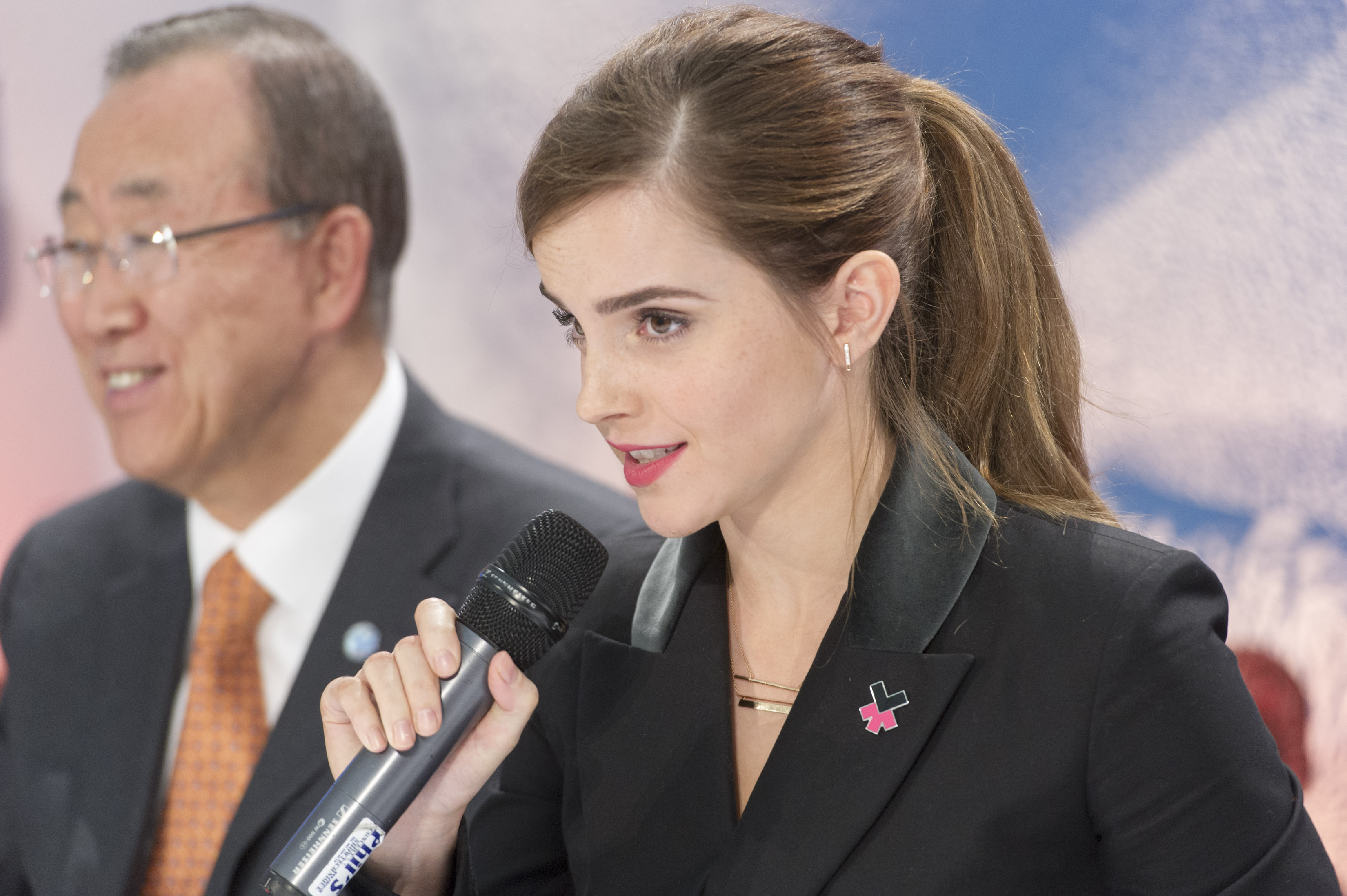
At the World Economic Forum, Watson launched HeForShe IMPACT 10×10×10 — securing concrete gender-equality commitments from 10 heads of state, 10 global CEOs, and 10 university presidents, turning sentiment into institutional accountability with measurable targets and public reporting.
Founded a global feminist book club on Goodreads — 200,000+ members reading bell hooks, Chimamanda Ngozi Adichie, Gloria Steinem, and Roxane Gay. At the UN, she delivered a second landmark speech on making universities safe for women, launching HeForShe's university initiative across dozens of institutions.
Watson travelled to meet activists, students, and lawmakers in countries from Uruguay to Malawi, listening as much as speaking. She used red-carpet press for Beauty and the Beast to redirect attention toward gender equality, and was named one of Time's 100 Most Influential People.
Watson donated £1 million to the UK Justice and Equality Fund fighting workplace harassment, becoming its largest founding donor, and helped launch Time's Up UK alongside 200 British women in film and theatre. She also funded a free legal advice line for women experiencing harassment at work.
Invited by President Emmanuel Macron to join the G7's Gender Equality Advisory Council — advising the world's largest economies on legislation against gender-based violence and discrimination, and helping compile a body of laws for governments to adopt.
Watson joined the board of luxury group Kering, chairing its sustainability committee — bringing her advocacy into the boardroom of a major corporation and proving that activism and governance need not be separate worlds.
UN Solidarity Campaign · 2014
A global movement calling on men and boys to stand as advocates for gender equality — active in all 193 UN member states, with billions of conversations generated and over two million direct commitments.
Feminist Book Club · 2016
Watson's Goodreads book club turned her audience into a reading movement — one feminist text every two months, from "The Color Purple" to "Persepolis," discussed by hundreds of thousands worldwide.
Justice & Equality Fund · 2018
Her £1M founding donation seeded a legal-support network for women facing harassment at work — extending the movement beyond Hollywood to every industry and income level.
HeForShe did not appear from nowhere — it stands on a century of international women's rights architecture that Watson's work consciously extends.
The UN Commission on the Status of Women — the first global intergovernmental body dedicated to gender equality.
The international bill of rights for women — ratified by 189 states, creating binding obligations to end discrimination.
189 governments adopt the most comprehensive women's rights agenda ever assembled, across 12 critical areas.
All 193 UN states commit to achieving gender equality for all women and girls by 2030 — the goal HeForShe serves.
"If not me, who? If not now, when?"
The question that closed the speech — and opened a movement
Emma Watson's cultural legacy is unusual in its duality. She is simultaneously a child of the screen, formed entirely by public eyes, and a woman who chose to reclaim her narrative with extraordinary intentionality — stepping back from celebrity at precisely the moment it offered the most.
Her choice to prioritise education over box-office returns, to use a UN platform to advance substantive policy rather than symbolic gestures, and to align personal consumer choices with political convictions has made her a model of integrated integrity in an era that rarely rewards it.
And the movement she ignited continues without her needing to stand at its centre — in lecture halls, in legislation, in the simple fact that a generation of young men now call themselves feminists without flinching.
UN Women Goodwill Ambassador
Appointed by Secretary-General Ban Ki-moon
Time 100 Most Influential People
For redefining celebrity advocacy
Feminist Celebrity of the Year
Ms. Magazine
First Gender-Neutral Acting Award
MTV Movie Award — Beauty and the Beast
Largest Founding Donor, Justice & Equality Fund
£1M to fight workplace harassment
G7 Gender Equality Advisory Council
Appointed by President Emmanuel Macron
For ten years, across eight films, Watson was Hermione Granger — the brilliant, brave, rule-bound witch who became a feminist touchstone for an entire generation of readers and viewers. She auditioned eight times, was nearly recast as she grew, and ultimately defined the character so completely that author J.K. Rowling said she could imagine no one else. The role made her one of the highest-paid actresses in the world before she had finished school.
Watson returned to franchise scale as Belle in Disney's live-action remake — but on her own terms. She reconceived Belle as an inventor rather than a passive heroine, insisted the character's agency be strengthened, performed all her own singing, and refused a corset, arguing it was inconsistent with an active young woman. The film became the highest-grossing live-action musical of all time at its release and the second-highest-grossing film of 2017.
as Sam — dir. Stephen Chbosky
Watson's first major post-Potter role was, by design, the opposite of Hermione: an American high-schooler, warm and wounded, navigating first love and trauma. Critics called it a revelation. She mastered a flawless Pittsburgh accent and proved decisively that her range extended far past the wizarding world. The film became a cult touchstone for a generation of teenagers.
as Nicki — dir. Sofia Coppola
A daring, satirical turn as a vapid, fame-obsessed Los Angeles teenager who burgles celebrities' homes. Watson deliberately played against her wholesome image with deadpan comic precision — a knowing commentary on the very celebrity culture she had grown up inside. Sofia Coppola praised her fearlessness and total commitment to an unlikeable character.
as Ila — dir. Darren Aronofsky
Watson joined Russell Crowe and Anthony Hopkins in Aronofsky's ambitious biblical epic, playing Ila, the adopted daughter whose arc carries much of the film's emotional weight. The role placed her opposite some of cinema's heaviest hitters and demonstrated her capacity for large-scale dramatic work in a serious auteur's hands.
as Lena & Angela Gray
Two darker, adult dramas in a single year — a political thriller set in Pinochet's Chile (Colonia) and a psychological mystery opposite Ethan Hawke (Regression). Both showed Watson deliberately seeking weightier, riskier material as she moved firmly into adult roles and away from the safety of franchise work.
as Mae Holland — dir. James Ponsoldt
Opposite Tom Hanks, Watson led this techno-thriller about surveillance, privacy, and the seductions of a Silicon Valley giant — themes that resonated pointedly with her own experience of being relentlessly watched. She carried the film as its protagonist, anchoring a cautionary tale about the cost of a life lived entirely in public.
as Meg March — dir. Greta Gerwig
A career high-water mark. Watson joined Saoirse Ronan, Florence Pugh, Eliza Scanlen, Laura Dern, and Meryl Streep in Greta Gerwig's acclaimed adaptation of Louisa May Alcott's novel. As Meg — the eldest March sister, torn between love and ambition — Watson grounded the film's quietest, most domestic emotional truths. It earned six Academy Award nominations including Best Picture.
Gender equality is not a women's issue — it is a human issue. Join the movement Emma Watson helped ignite, and stand with the women and girls still fighting for rights that should never have been in question.